Why Affiliate Marketing is so Hot

Why Affiliate Marketing is so Hot

Imagine you are a newbie affiliate entering the industry today. Which vertical would you choose? What would be your strategy for success?

Evgenii “Geno” Prussakov: In late 2015 we conducted a comprehensive analysis of 550 top affiliate programs across 6 major U.S. affiliate networks (CJ, Rakuten, ShareASale, AvantLink, Affiliate Window, and LinkConnector). Which revealed that more than 88% of the top-earning programs may be placed into 20 broad categories. Continue reading

Introducing Progressive Web Apps: What They Might Mean for Your Website and SEO

Introducing Progressive Web Apps: What They Might Mean for Your Website and SEO

The author’s views are entirely his or her own (excluding the unlikely event of hypnosis) and may not always reflect the views of Moz.

How to Connect Constant Contact to WordPress

How to Connect Constant Contact to WordPress (Step by Step)

Special WordPress Hosting offer for WPBeginner ReadersHow to Connect Constant Contact to WordPress (Step by Step)

Are you using ConstantContact for your email marketing? Want to connect ConstantContact with your WordPress site?

In this ultimate guide, we will show you how to connect ConstantContact with WordPress.
 

Using Constant Contact with WordPress - The Ultimate Guide

Using Constant Contact with WordPress – The Ultimate Guide

Why Building an Email List is so Important?

Have you ever wondered that why every website on the internet wants to have your email address?

Whether you are creating an account on Facebook, Twitter, or New York Times, they all want your email address.

The answer is dead simple. Email is the best way to reach your customers.

A recent study showed that small businesses get $40 back for every dollar spent on email marketing.

It is the most effective way to convert visitors into customers.

You can learn more about this topic by reading our article on why you should start building your email list right away.

Now that you know the importance of building an email list, let’s see how to get started with Constant Contact to build an email list for your WordPress site.

What is Constant Contact?

Constant Contact is one of the most popular email marketing service providers in the world.

They specialize in sending mass emails to your customers, manage your email lists, and run effective email marketing campaigns.

It can be quite overwhelming for small businesses to start their own email list. Constant Contact makes sure that even absolute beginners can run their email campaigns like a pro.

It is a paid service with a free 2-month trial. After the trial period, pricing starts as low as $20 per month.

How to Set up Constant Contact

Sign up for a Constant Contact account

First, you need to visit Constant Contact website and sign up for an account.

Sign up for a Constant Contact account

Upon signing up, you will land on the Constant Contact dashboard. You will see three simple steps to help you get started.

Constant Contact dashboard

Step 1: Setting up your first email list

First, you need to click on ‘Set up your first list’ link. This will bring up a popup where you need to provide a name for your email list and some email addresses to add to it.

Next, click on the save list button to continue.

Step 2: Add your organization info

The CAN-SPAM act requires a valid postal address in all outgoing marketing emails. Constant Contact makes it easy for you to comply with this law by providing your organization info.

Constant Contact will then automatically add this information in the footer of your emails.
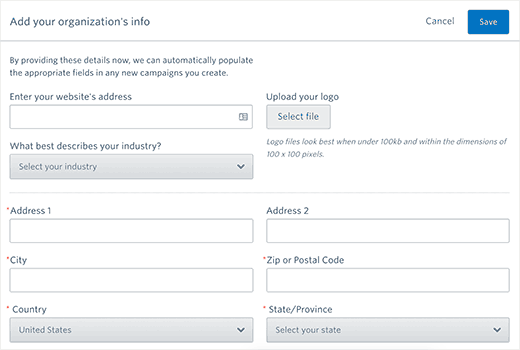
 

Add your organization information


You need to click on ‘Add your organization info’ link. It will take you to a form where you need to provide your business information.

Add your organization information

You will need to provide your website address and postal address. You will also be asked to select an industry for your business and upload an image logo.

Don’t forget to click on the save button to store your settings and continue to the next step.

Step 3: Send your first email

Lastly, you need to click on ‘Send your first email’ link.

Constant Contact will show you a number of beautiful email templates to choose from.

Select a template for your first email

This will open the template in Constant Contact’s live WYSIWYG email composer. This drag and drop design tool allow you to easily design your email.

First, you need to provide a title for your campaign. After that, you can replace the images used in the template with your own, add your own text and branding.

Compose email

Click on the continue button when you are satisfied with the result.

Now you will reach the email options page. This is where you need to select which email list to use when to send an email, or change sender name and reply-to email address.

Email options

Once you are done, click on the Send Now or Schedule button to continue.

That’s all, you have successfully finished setting up your Constant Contact account.

Adding Constant Contact Signup Forms in WordPress

Now that you have set up your Constant Contact account, the next step is to collect email addresses by asking users to join your email list.

There are multiple ways to do this.

You can copy and paste the signup form code from your Constant Contact account to your WordPress site.

You can also use OptinMonster to add highly optimized signup forms to your WordPress site.

It will help you get many more email subscribers faster. See our case study of how we increased our email subscribers by 600% using OptinMonster.

We will show you both of these methods in this guide. Let’s get started.

Adding Default Constant Contact Signup Forms in WordPress

Constant Contact comes with built-in tools to create your email signup forms. You can then embed these forms into your WordPress site.

First, you need to login to your Constant Contact account and then click on ‘Contacts Growth Tools’ from the navigation menu on top.

Contacts growth tools

On the next page, you need to click on create a signup form button.

Create a signup form

This will bring you to the form builder wizard.

First, you need to provide the form name. This name will be used internally so that you can identify a form in Constant Contact dashboard.

Signup forms details

Next, you need to provide a title and tagline for your form. Both of them will be visible on your form.

Lastly, you need to select at least one email list. Users signing up using this form will be added to these lists.

Click on the continue button for the next step.

Now you need to add the fields you want to display on your signup form. The email address field is required.

You can click on ‘Additional fields’ to add more fields to your signup form.

Add fields to your email signup form

After adding the form fields, click on the continue button.

In the last step, you can choose your font color, background color, and add a logo.

Change form appearance

You can click on the preview button to see how your form looks. Once you are satisfied, click on the ‘Finish’ button.

You will be redirected back to the contacts growth tools page.

You need to click on the actions drop down menu and then select ‘Embed Code’.

Get embed code for your signup form

This will bring up a popup with the embed code to add your form anywhere. You need to copy this code and paste it into a text editor like Notepad.

Embed code for your signup form

Now visit your WordPress admin area and click on Appearance » Widgets.

From the list of available widgets, drag and drop the Text widget to a sidebar where you want to display your signup form.

Paste the code you copied from Constant Contact website in the widget’s text area. Once you are done, click on the save button to store your widget settings.

That’s all, you can now visit your website to see the signup form in action.

Constant Contact email signup form in WordPress

Adding Constant Contact Signup Forms with OptinMonster

While the basic forms are relatively easy to add, they are not ideal for high conversions.

An average user visiting your website spends very little time looking at the non-content element. You need email signup forms that grab your user’s attention.

This is where OptinMonster comes in. It is the most popular lead generation tool in the market. You can create beautiful sign-up forms that are optimized for conversions and A/B test them without hiring a developer.

OptinMonster comes with different kinds of signup forms such as exit-intent popups, floating bars, after post forms, sidebar forms, slide-in forms, full-screen welcome gates, and more.

You also get powerful features like MonsterLinks (2-step options), Scroll detection, A/B testing, page level targeting, and more.

OptinMonster works great with WordPress and all popular email service providers including Constant Contact.

Send WordPress Posts to Your Constant Contact Email List

Constant Contact makes it super simple to add your WordPress content into your email campaigns.

Note: Constant Contact does not currently offer automatic sending of blog posts to the email list.

First, login to your Constant Contact account and visit the Campaigns page. You need to click on the create button and then select send a new email.

Send an email

You will be asked to select a template for your email. After that you will reach the email builder screen.

From the left pane drag and drop the “Read More” block into your email preview. Next, click on the read more block in the email preview to edit it.

Add read more content block

This will bring up a popup window. You need to provide the URL of your WordPress blog post and click on the preview button.

Constant Contact will automatically fetch an image from your article and an article summary. You can click on the Insert button to add it to your email.

Fetch blog content into your email

Repeat the process to add more content from your WordPress blog into your email. Once you are done, go ahead and click on the continue button.

You will then reach the last step of creating your email. This is where you can select whether you want to send the email right away or schedule it.

That’s all, Constant Contact will now send your email with your blog content to your subscribers.

We hope this article helped you learn how to connect Constant Contact to WordPress.

Please follow us on Facebook, Twitter, Google+

Introducing Progressive Web Apps: What They Might Mean for Your Website and SEO

Introducing Progressive Web Apps: What They Might Mean for Your Website and SEO

Progressive Web Apps. Ah yes, those things that Google would have you believe are a combination of Gandhi and Dumbledore, come to save the world from the terror that is the Painfully Slow WebsiteTM.

But what actually makes a PWA? Should you have one? And if you create one, how will you make sure it ranks? Well, read on to find out.

What’s a PWA?

Given as that Google came up with the term, I thought we’d kick off with their definition:

The really exciting thing about PWAs: they could make app development less necessary. Your mobile website becomes your app.

Speaking to some of my colleagues at Builtvisible, this seemed to be a point of interesting discussion: do brands need an app and a website, or a PWA.

Fleshing this out a little, this means we’d expect things like push notifications, background sync, the site/app working offline. Having a certain look/design to feel like a native application, and being able to be set on the device home screen.

These are things we traditionally haven’t had available to us on the web.

But thanks to new browsers supporting more and more of the HTML5 spec and advances in JavaScript, we can start to create some of this functionality. On the whole, Progressive Web Apps are:

This method of loading content allows for incredibly fast perceived speed.

We are able to get something that looks like our site in front of a user almost instantly, just without any content.

The page will then go and fetch the content and all’s well. Obviously, if we actually did things this way in the real world, we’d run into SEO issues pretty quickly, but we’ll address that later too.

If then, at their core, a Progressive Web App is just a website served in a clever way with extra features for loading stuff, why would we want one?

The use case

Let me be clear before I get into this: for most people, a PWA is something you don’t need.

That’s important enough that it bares repeating, so I’ll repeat it:

You probably don’t need a PWA.

The reason for this is that most websites don’t need to be able to behave like an app.

This isn’t to say that there’s no benefit to having the things that PWA functionality can bring. But for many sites, the benefits don’t outweigh the time it takes to implement the functionality at the moment.

When should you look at a PWA then? Well, let’s look at a checklist of things that may indicate that you do need one…

Signs a PWA may be appropriate

You have:

  • Content that regularly updates, such as stock tickers, rapidly changing prices or inventory levels, or other real-time data
  • A chat or comms platform, requiring real-time updates and push notifications for new items coming in
  • An audience likely to pull data and then browse it offline, such as a news app or a blog publishing many articles a day
  • A site with regularly updated content which users may check into several times a day
  • Users who are mostly using a supported browser

In short, you have something beyond a normal website, with interactive or time-sensitive components, or rapidly released or updated content.

A good example is the Google Weather PWA:

Progressive Web Apps

If you’re running a normal site, with a blog that maybe updates every day or two, or even less frequently, then whilst it might be nice to have a site that acts as a PWA. There’s probably more useful things you can be doing with your time for your business.

How they work

So, you have something that would benefit from this sort of functionality, but need to know how these things work. Welcome to the wonder that is the service worker.

Service workers can be thought of as a proxy that sits between your website and the browser.

It calls for intercept of things you ask the browser to do, and hijacking of the responses given back.

That means we can do things like, for example, hold a copy of data requested.Sso when it’s asked for again, we can serve it straight back (this is called caching).

This means we can fetch data once, then replay it a thousand times without having to fetch it again.

Think of it like a musician recording an album. It means they don’t have to play a concert every time you want to listen to their music. Same thing, but with network data.

If you want a more thorough explanation of service workers, check out this moderately technical talk given by Jake Archibald from Google.

What service workers can do

Service workers fundamentally exist to deliver extra features, which have not been available to browsers until now. These includes things like:

  • Push notifications, for telling a user that something has happened, such as receiving a new message. Or that the page they’re viewing has been updated
  • Background sync, for updating data while a user isn’t using the page/site
  • Offline caching, to allow a for an experience where a user still may be able to access some functionality of a site while offline
  • Handling geolocation or other device hardware-querying data (such as device gyroscope data)
  • Pre-fetching data a user will soon require, such as images further down a page

It’s planned that in the future, they’ll be able to do even more than they currently can. For now, though, these are the sorts of features you’ll be able to make use of. Obviously, these mostly load data via AJAX, once the app is already loaded.

What are the SEO implications?

So you’re sold on Progressive Web Apps. But if you create one, how will you make sure it ranks?

As with any new front-end technology, there are always implications for your SEO visibility. But don’t panic; the potential issues you’ll encounter with a PWA have been solved before by SEOs who have worked on JavaScript-heavy websites.

For a primer on that, take a look at this article on JS SEO.

There are a few issues you may encounter if you’re going to have a site that makes use of application shell architecture.

Firstly, it’s pretty much required that you’re going to be using some form of JS framework or view library, like Angular or React. If this is the case, you’re going to want to take a look at some Angular.JS or React SEO advice.

If you’re using something else, the short version is you’ll need to be pre-rendering pages on the server. Then picking up with your application when it’s loaded.

This enables you to have all the good things these tools give you, whilst also serving something Google et al can understand.

Their recent advice that they’re getting good at rendering this sort of application. We still see plenty of examples in the wild of them flailing horribly when they crawl heavy JS stuff.

Assuming you’re in the world of clever JS front-end technologies, to make sure you do things the PWA way. You’ll also need to be delivering the CSS and JS required to make the page work along with the HTML.

Not just including script tags with the <code>src attribute, but the whole file, inline.

Obviously, this means you’re going to increase the size of the page you’re sending down the wire. But it has the upside of meaning that the page will load instantly.

More than that, though, with all the JS (required for pick-up) and CSS (required to make sense of the design) delivered immediately. The browser will be able to render your content and deliver something that looks correct and works straight away.

Again, as we’re going to be using service workers to cache content once it’s arrived, this shouldn’t have too much of an impact.

We can also cache all the CSS and JS external files required separately, and load them from the cache store rather than fetch them every time.

This does make it very slightly more likely that the PWA will fail on the first time that a user tries to request your site. But you can still handle this case gracefully with an error message or default content, and re-try on the next page view.

There are other potential issues people can run into, as well. The Washington Post, for example, built a PWA version of their site, but it only works on a mobile device.

Obviously, that means the site can be crawled nicely by Google’s mobile bots, but not the desktop ones.

It’s important to respect the P part of the acronym — the website should enable features that a user can make use of, but still, work in a normal manner for those who are using browsers that don’t support them.

It’s about enhancing functionality progressively, not demanding that people upgrade their browser.

The only slightly tricky thing with all of this is that it requires that, for the best experience, you design your application for offline-first experiences.

How that’s done is referenced in Jake’s talk above. The only issue with going down that route: you’re only serving content once someone’s arrived at your site and waited long enough to load everything.

Obviously, in the case of Google, that’s not going to work well. So here’s what I’d suggest…

Rather than just sending your application shell, and then using AJAX to request content on load, and then picking up, use this workflow instead.

  • User arrives at site
  • The site sends back the application shell (the minimum HTML, JS, and CSS to make everything work immediately), along with…
  • …the content AJAX response, pre-loaded as state for the application
  • The application loads that immediately and then pick up the front end.

Adding in the data required means that, on load, we don’t have to make an AJAX call to get the initial data required.

Instead, we can bundle that in too, so we get something that can render content instantly as well.

As an example of this, let’s think of a weather app. Now, the basic model would be that we send the user all the content to show a basic version of our app, but not the data to say what the weather is.

In this modified version, we also send along what today’s weather is, but for any subsequent data request, we then go to the server with an AJAX call.

This means we still deliver content that Google et al can index, without possible issues from our AJAX calls failing.

From Google and the user’s perspective, we’re just delivering a very high-performance initial load, then registering service workers to give faster experiences for every subsequent page and possibly extra functionality.

In the case of a weather app, that might mean pre-fetching tomorrow’s weather each day at midnight, or notifying the user if it’s going to rain, for example.

Going further

If you’re interested in learning more about PWAs, I highly recommend reading this guide to PWAs by Addy Osmani (a Google Chrome engineer), and then putting together a very basic working example, like the train one Jake mentions in his YouTube talk referenced earlier.

If you liked this article, then please find us on  Facebook, Twitter, Google+

RIP Google Page Rank Score

RIP Google Page Rank score: A retrospective on how it ruined the web

While Google will remove google page rank scores from public view in the coming weeks, the way those scores dramatically reshaped the web will remain. Continue reading

Design a site like this with WordPress.com
Get started